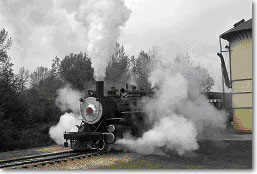
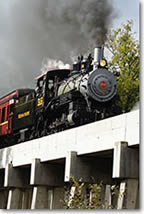
Engine 300 is one of two surviving United States Army “Pershing” engines. This type of engine was named after General “Blackjack” Pershing and built for service in Europe during World War One. Fortunately, this locomotive remained in the United States, primarily serving the Camp Polk Army Base in Leesville, Louisiana.
This engine is a 2-8-0 type, meaning that it has two wheels in the front, eight drivers in the middle and no wheels at the rear of the engine. This wheel arrangement is commonly referred to as a “Consolidation”.
At the end of WWII the locomotive was acquired by the Tremont and Gulf Railroad, a Louisiana Short line. The T. & G. completely rebuilt the engine and renumbered it 28. The T. & G. sold number 28 to the Southern Pine Lumber Company, and East Texas short line operated by the Temple Lumber Company. After years of dedicated service, the company owner, Mr. Arthur Temple, donated the engine to the Texas State Railroad in 1973.
The engine was brought to the railroad in 1976. Boiler problems and budget restraints delayed restoration efforts until the late eighties when work began on obtaining a new boiler for the old war-horse. All running gear and appliances were completely reworked or replaced. After years of effort, engine 300 was put into active service on April 13, 1996 to commemorate the Texas State Railroad’s Centennial celebration. From her humble origins of hauling freight, lumber and munitions to her present occupation of transporting tourist and rail fans of all ages, Engine 300 has done it all with style and grace.
Engine
Builder
Year
Wheel Arrangement
316
A.L. Cooke
1901
4-6-0
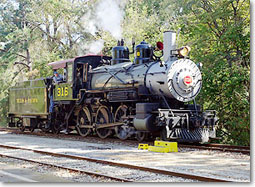
In the fall of 2012, Engine 201 was given a fresh coat of paint and re-named Texas & Pacific 316. This was done to reflect the engine’s history and operating number through 1949. Engine 316 celebrated her 111th birthday on November 3, 2012 with a Photo Excursion. Dozens of train enthusiasts rode the train that day and captured 316’s special day to share on their websites and blogs.
Engine number 201 is the oldest locomotive operated on the line. This engine was built in 1901 by the A.L. Cooke Locomotive Works for the Texas & Pacific Railway, and is the only operating T&P steam locomotive in existence. The engine was built for freight service and proudly wore the number 316 during its career with the Texas & Pacific.
Engine 201 is classified as a 4-6-0. This means that it has four wheels in the front, six drivers in the middle and no wheels in the rear of the engine. This type of locomotive is commonly referred to as a "ten wheeler."
In 1949, after years of hard service, the Texas & Pacific sold number 316 to the Paris & Mt. Pleasant Railroad, a T&P subsidiary. In 1951 the locomotive was saved from the scrapper's torch by a remarkable lady who wished to remain anonymous. She purchased the engine and, with the help from the T&P, donated it to the city of Abilene in honor of its seventy-fifth anniversary as a city.
The venerable ten wheeler remained on display in Abilene at the Oscar Rose Park for many years, wearing the number 75 to symbolize the seventy-fifth Jubilee Celebration of the City.
In 1974 the citizens of Abilene graciously donated the locomotive to the newly formed Texas State Railroad. After extensive repair and refurbishing, the engine was again rolling down the rails to thrill a new generation of train passengers.
The 201 was recently refurbished and unveiled during October 2006 and is currently used during steam excursions at the Texas State Railroad.
Engine
Builder
Year
Wheel Arrangement
7
ALCO
1947
rebuilt - 2005
0-4-4-0
Engine number 7 is the second oldest diesel locomotive operated on the Texas State Railroad. This engine was built in 1947 by the American Locomotive Company at their Schenectedy, New York, locomotive plant for the Point Comfort & Northern Railroad of Lolita, Texas.
The Point Comfort & Northern was owned and operated by Alcoa (Aluminum Company of America) and served their aluminum manufacturing plant at Point Comfort, Texas. This type of engine is representative of the first wave of diesel engines that started replacing steam locomotives immediately after the end of World War II.
This engine saw many miles of road service for the Point Comfort & Northern, carrying train load after train load of material all over the eastern part of Texas.
Finally, when the hardworking road switcher seemed to be heading toward the scrap heap, its career took an unexpected turn.
In 1975 the fledgling Texas State Railroad was looking for a diesel engine to provide backup service to its steam locomotives. The officials at Alcoa decided to donate the hardworking engine number 7 to the Texas State Railroad. This diesel is still at the Texas State Railroad to this day; pulling work trains, carloads of ballast and pulling passenger trains.
Engine
Builder
Year
Wheel Arrangement
8
ALCO
1953
0-6-6-0
TSRR diesel locomotive Number 8 is an ALCO, MRS 3 (ex-military). This standard gauge engine came to the Texas State Railroad in February 1982 from the U. S. Army Ammunition Plant, McAlester, Oklahoma.
The ALCO RS-3 locomotives are B-B road switchers. They were built to compete with EMD, Fairbanks-Morse and Baldwin Locomotive Works. EMD won the production race with 2,729 GP-7s built to ALCO’s 1,418 RS-3s whose design and performance were quite competitive. Out of the 1,418 built 1,265 ran for American railroads, 98 for Canadian railroads, 48 for Brazilian and 7 for Mexican railroads.
We are proud to have this example still plying the rails of the TSRR as a work engine and hauling passengers. Number 8 is a fine example of the early larger engined diesels that began to replace steam locomotives in the early and mid-50’s as they offered greater flexibility and performance, as well as substantially lower operating and maintenance costs.
Engine
Builder
Year
Wheel Arrangement
400
Baldwin Locomotive
Works
1917
2-8-2
This locomotive began its career on the Tremont & Gulf Railway, a Louisiana short line. Wearing number 30, it was built by the Baldwin Locomotive Works in 1917. The engine is a 2-8-2 type, which means it has two small wheels at the front of the engine, eight drivers (the large wheels), and two small wheels at the rear of the engine. This type of locomotive is commonly referred to as a “Mikado” because the first engines of this wheel arrangement were ordered by the government of Japan.
The Tremont & Gulf operated this locomotive until 1954, when it was sold to the Magma Copper Mine in Magma, Arizona. During its tenure at the mine the locomotive was utilized in the 1962 epic MGM movie How the West Was Won. Viewers of this movie recall this spectacular train crash scene the engine was featured in. The mine replaced its steam engines with diesel power in the late sixties, seemingly ending the long career of the lanky Mikado. However, in 1974, it came out of its brief retirement.
Texas State Railroad staff, scouring the country in search of viable steam locomotives, located and purchased this engine. It was shipped by rail to Texas and underwent extensive repair and refurbishing. After several years of hard work the Mikado was once again ready to go to work in 1978, rolling down the iron rails with style and grace to thrill a new generation of rail enthusiasts.
Please contact us at:
Info@railsnw.com
Rail News & Updates
Travelling between either Rusk or Palestine, a day on the Texas State Railroad is an unforgettable trip for any adventurer.
With Summer quickly approaching, book your day trip now before all the seats are taken!


 In the fall of 2012, Engine 201 was given a fresh coat of paint and re-named Texas & Pacific 316. This was done to reflect the engine’s history and operating number through 1949. Engine 316 celebrated her 111th birthday on November 3, 2012 with a Photo Excursion. Dozens of train enthusiasts rode the train that day and captured 316’s special day to share on their websites and blogs.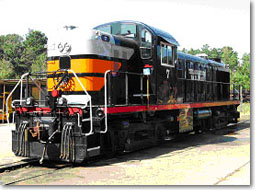
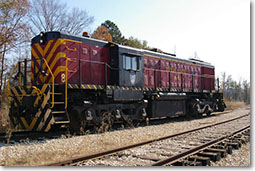 TSRR diesel locomotive Number 8 is an ALCO, MRS 3 (ex-military). This standard gauge engine came to the Texas State Railroad in February 1982 from the U. S. Army Ammunition Plant, McAlester, Oklahoma.